Mobile

Mobile

Monday, June 1, 2015

Guide How to use the Sony QX10 with Android and iOS

The Sony Cyber ​​-shot QX10 as an additional lens for smart phones . In fact this is a real camera because it includes a 10X zoom lens system , 18MP image sensor Exmor R and BIONZ processor . Do turn off the monitor and control system should smartphone will act as a viewfinder , and the user will manipulate directly on it . QX10 using Wi -Fi connectivity directly between devices , NFC will also help to simplify the connection more . Tests showed the connection speed between the QX10 and stable smartphone , in a variety of environments with Wi- Fi , you will feel a little interface will have latency from 0.5 to 2 seconds .

 Click to Watch

Lenovo officially launches tablets IdeaPad B6000-F and B8000-F unique design

Chinese manufacturer Lenovo has just announced the duo tablet running Android operating system called Lenovo IdeaPad B6000-F and B8000-F owns quite unique design with integrated base to help the user can use the two investment different positions . With this base , we can build Lenovo IdeaPad B6000-F and B8000-F up as well as create a screen tilt required when using the machine on a table . Besides this hinge , the two new Lenovo tablet also more emphasis on key design with source size .
Lenovo officially launches tablets IdeaPad B6000-F and B8000-F
Not only are similar in design, the Lenovo IdeaPad B6000-F and B8000-F also share many characteristics of the configuration . These include a quad-core processor MediaTek MT8125 1.2GHz with 1 GB RAM , 5 megapixel rear camera and Android operating systems . The difference between this tablet is the battery screen : Lenovo IdeaPad B6000-F, 8 inch screen uses the same 6000 mAh capacity batteries while Lenovo IdeaPad B8000-F, screen is 10.1 inches longer use is 9,000 mAh battery .
The price of Lenovo tablets duo has not been revealed in detail.

Friday, April 24, 2015

Volvo ditches the passenger seat for a new luxury Interior

Volvo ditches the passenger seat for a new twist on chauffeur-driven luxury


The Lounge Console offers the legroom that can only come without a front seat
Image Gallery (14 images)
You could argue that the passenger seat is largely redundant in a chauffeur-driven vehicle, aside from providing a handy place for the driver to put their packed lunch and newspaper. Volvo is looking to make better use of that space – for the rear-seat passenger at least – by removing the passenger seat and replacing it with a multi-purpose luxury footrest.
Launched at the Shanghai International Auto Show, the Volvo Lounge Console is a concept designed to provide chauffeur-driven businesspeople with extra storage and comfort. The console sits in place of the passenger seat and incorporates a mirror, TV screen and storage compartment.
A lockable box is there if you're afraid of having your valuables nicked
For buyers who want to keep up with work on the move, the Lounge Console incorporates an aircraft-aping tray table that provides space for a computer and notes. Rolling the table 90 degrees reveals another one of the Lounge Console's tricks in the form of a 17-inch TV screen that puts the 10- and 11-inch rear-seat media units in other luxury cars to shame.
Opening up the tray table reveals a fully illuminated vanity mirror, which includes a storage tray for jewellery or makeup. Hiding underneath the Lounge Console's padded leg rest is a storage compartment designed for for the well-heeled's shoes, while Volvo has also included a lockable storage box, just in case owners have anything they want to hide from a shifty chauffeur. The uninterrupted front view is also claimed to give the impression of a more spacious ride.
So what has inspired Volvo's decision to remove the passenger seat? If you ask the company, it will probably say the idea came from something along the lines of "ethnographic research to establish the unexpressed and unmet needs of people with a high-profile lifestyle."
If you're keen to get work done, the Lounge Console includes a tray table
But we suspect it has more to do with the burgeoning Chinese luxury market. After all, Volvo used the Shanghai Auto Show to unveil a new ultra-luxury Excellence version of its XC90 SUV, while Audi used the show to display a long wheelbase A6 exclusively designed for China. So it's no surprise to see manufacturers going above and beyond to win the attention of China's new-money luxury car buyers.
The Lounge Console is only a concept for now, with no word from Volvo on whether it will make production or not.
Source: Volvo

Monster Routers from D-link

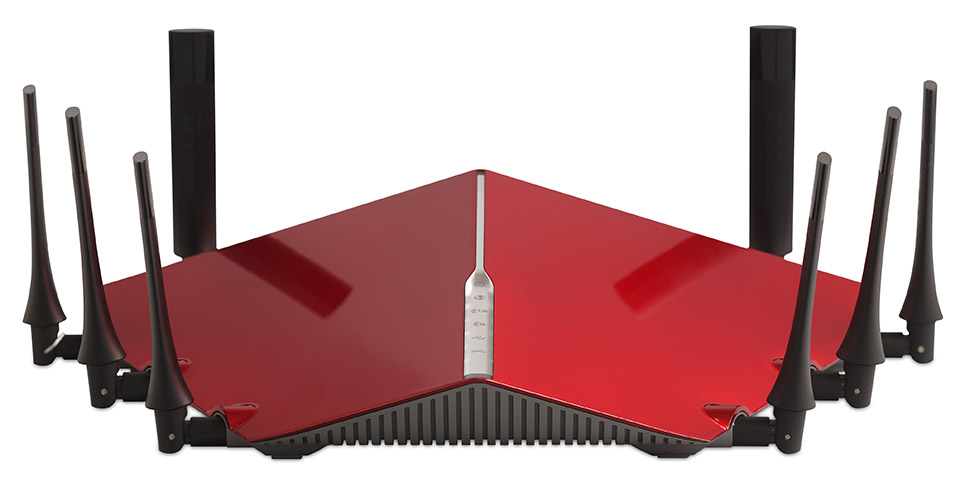
D-Link's new routers look crazy, but they're seriously fast

File_4257, 10/1/14, 3:30 PM,  8C, 2690x4792 (2504+1507), 100%, bent 6 stops,  1/30 s, R68.0, G26.5, B20.9
D-Link has just jumped the router shark with its latest AC5300, AC3200 and AC3100 Ultra Performance models. On top of speeds up to 5.3Gbps for the AC5300 model, the 802.11ac devices feature, um, striking looks that hopefully won't frighten animals or small children. D-Link calls the models "attractive" with a "modern form factor for today's homes," and we'd agree -- provided you live in some kind of rouge-accented spaceship. Performance-wise, however, the new models are definitely drool-worthy, thanks to 802.11ac tri-band beamforming speeds between 3.1 and 5.3 Gbps, along with Gigabit Ethernet, high-power antennas and onboard USB 3.0 ports.
You can control the devices with a smartphone or tablet, and D-Link also outed an optional DWA-192 USB 3.0 adapter, which connects to laptops and PCs to give them an 802.11ac connection. The AC3200 model will run $310 and is available now from Newegg, while the rest of the pricing and models will come next quarter.
On top of the wireless stuff, D-Link also announced new PowerLine HomePlug kits, with speeds up to 2Gbps. The company says the DHP-701AV (2 Gbps) and DHP-601AV (1Gbps) adapters use the fastest two wires in a typical three-wire power installation with pushbutton connection for ease of installation and security. Both kits come with two adapters and will run $130 (DHP-701AV) and $80 (DHP-601AV), with both arriving later this quarter.

Thursday, April 23, 2015

Is the Sony C3 the Best Phone For Selfies?.....

Sony claims its Xperia C3 is the world's best smartphone for selfies


Sony says its new Xperia C3 is the 'world’s best selfie smartphone'
Image Gallery (3 images)
Regardless of your take on them, selfies have become such a phenomenon as to spawn specially designed cameras and shooting modes. Now Sony is getting in on the action with the Xperia C3, proclaiming it as the "world’s best selfie smartphone."
Sony is framing the phone's marketing around its 5 MP wide-angle front-facing camera that allows users to fit more than would usually be possible into the frame from a short distance. The camera has a 25 mm lens with an 80 degree field of view.
A soft light flash aims to help users take flattering self-portrait shots and users can trigger shots by smiling using Sony's Smile Shutter technology. A Superior Auto mode can be employed to have the C3 automatically select what it deems to be the best shot settings for the light conditions and an high-dynamic range mode is available for producing more vivid images.
The C3 features a 5 MP wide-angle front-facing camera for taking selfies
The C3 provides a variety of apps and effects to enhance shots. Portrait Retouch allows users to give photo subjects a "makeover," adding effects like eye reflection patterns or blush (it looks similar to Apple's Photo Booth feature in OS X and iOS, only focusing more on makeup effects). There are also options for adding real-time effects like pirate costumes and teddy bear heads.
In addition to the front-facing camera, the C3 has an 8 MP rear camera, which features an Exmor RS CMOS image sensor, which aims to produce a high quality of image whilst being small in size. The main camera also features Sony's SteadyShot technology to help minimize blur and distortion.
Among its other useful features, the C3 offers dual-SIM support, letting users pop in different cards to make calls from different phone numbers. SIM cards can also be set up with different profiles, so, for example, each SIM can have a different ring tone.
The C3 has a 1.2 GHz Qualcomm Snapdragon processor, an Adreno 305 graphics processor and a...
Rounding out the specs, the C3 runs Android 4.4 KitKat with a quad-core 1.2 GHz Qualcomm Snapdragon processor under the hood. The C3's screen is one key area where it reveals its mid-range status, with 720p resolution spread across 5.5 inches (that's just 267 pixels per inch).

#Gadget_Battle....... Samsung Galaxy S6 (and GS6 edge) vs. iPhone 6

Samsung Galaxy S6 (and GS6 edge) vs. iPhone 6


Gizmag compares the features and specs of the Samsung Galaxy S6 (left), Galaxy S6 edge (mi...
Gizmag compares the features and specs of the Samsung Galaxy S6 (left), Galaxy S6 edge (middle) and iPhone 6
Image Gallery (29 images)
As recently as a year ago, iPhone vs. Galaxy showdowns required you to choose between premium builds and big screens. But now that the iPhone has a spacious screen, and the Galaxy has a high-end build, you're going to have to base your decision on other factors. Let Gizmag lend a hand, as we compare the features and specs of the Samsung Galaxy S6, Galaxy S6 edge and iPhone 6.

Size

Dimensions
The Galaxy S6 and Galaxy S6 edge are a little taller and wider than the iPhone 6, but all three are incredibly thin handsets – with the GS6 just barely taking the crown for thinnest of the bunch.

Weight

Weight
All three are very light for their respective sizes, but the Galaxy S6 edge gives you the best size-to-weight ratio (though the fact that its front face slopes off around the edges gives it an unfair advantage here).

Build (back)

Build (back)
With the Galaxy S6 and Galaxy S6 edge, Samsung is kissing plastic goodbye. Their glass (Gorilla Glass 4) backs put the phones in a premium stratosphere that we haven't seen from the company in years past.
Like in previous years, there's no questioning the quality of the iPhone's aluminum unibody design.

Build (sides)

Build (sides)
The GS6 and edge have aluminum sides, to complement those glass backs.

Colors

Color options
You'll have more color options to choose from for the pair of Galaxy phones.

Display (size)

Display (size)
The iPhone 6's screen size is much bigger than any pre-2014 iPhone's display, but it's still only 85 percent as big as the pair of 2015 Galaxy phones.
... of course if you want an even bigger iPhone, the iPhone 6 Plus is Apple's first phablet.

Display (resolution)

Display (resolution)
The iPhone 6 has a great display ... but it isn't even close to being as sharp as the Quad HD displays on the pair of Galaxies. There's a degree of eye candy there that the iPhone's 326 PPI display (the same density as 2010's iPhone 4) can't match.

Display (type)

Display (type)
Like in previous years, the two Samsung phones use Super AMOLED displays, while the iPhone sticks with an IPS panel.

Curved display

Curved display
Picking up where Samsung left off with the Galaxy Note Edge, the GS6 edge has a screen that slopes down on either side. It's largely cosmetic, but it will flash notifications and let you use some shortcuts on the edge displays.

Fingerprint sensor

Fingerprint sensor
Could this be the year that Samsung's fingerprint sensors catch up to Apple's? Unlike Samsung's 2014 sensors, the ones in the Galaxy S6 and GS6 edge will register with a touch – no swipe required. Apple's Touch ID has always been touch-based as well.

Battery

Battery
Stay tuned for more on this front. We do know that, in our video streaming test (over Wi-Fi, with brightness at 75 percent) the iPhone 6 dropped about 14 percent per hour. That's a good result, but off the pace of the longest-lasting phones we've handled.

Removable battery

Removable battery
Samsung flagships have historically had removable batteries, but those found in the GS6 and GS6 edge are sealed shut.

Fast charging

Gear VR compatibility
The GS6 and edge include a fast-charging tech that can give you an estimated 4 hours worth of uptime in just 10 minutes of charging (though you should only see that big of a difference when you start off with a nearly dead battery).

Camera megapixels (rear)

Camera megapixels (rear)
We'd take this with a few grains of salt, as the iPhone 6 easily has one of the best cameras you can find in a smartphone. We'll have more to say on the GS6's camera after we get our hands on a review unit.

Camera megapixels (front)

Camera megapixels (front)
The Galaxy phones may be better for selfies, with their higher-resolution (and wide-angled) front shooters.

Camera aperture

Camera aperture
The Galaxy phones' cameras come out with the wider aperture.

OIS

OIS
The iPhone 6 Plus has Optical Image Stabilization (OIS) on board, but the iPhone 6 doesn't – giving Samsung's phones a leg up for shaky-handed photographers.

Processor

Processor
We'd take this with a few grains of salt. It's quite possible the Galaxy S6 pair will have faster performance, but know that Apple's custom chips always outperform what you'd expect from their cores and clock speeds.

RAM

RAM
The Galaxy phones should, however, be the better choices for multitasking, as 3 GB of RAM is going to be better for that than 1 GB, no matter how you slice it.

Storage

Storage
No drastic differences here, though the entry-level Galaxy S6 and GS6 edge do give you double the storage of the base-level iPhone 6.

MicroSD

MicroSD
In exchange for that premium build, Samsung cut a few corners that were staples on its older flagships: microSD card slot being one of them.

Water resistance

Water resistance
This was the killer feature of the Galaxy S5, but Samsung dropped water/dust resistance from this year's flagships.

Heart rate sensor

Heart rate sensor
The Galaxy S6 and edge do, however, keep the heart rate sensor around for a second straight year.

Gear VR

Gear VR compatibility
There aren't any high quality virtual reality options for the iPhone at the moment, but the GS6 and edge play nicely with the new version of the Oculus-powered Gear VR.

Mobile payments

Mobile payments
Apple clearly set the tone here, as several months after the launch of Apple Pay, we now have – ahem – Samsung Pay.
Samsung's mobile payments solution is actually built on a brilliant premise, though: instead of requiring an NFC terminal (though it uses those too), it can also work with standard swipe-based credit card terminals. This makes it nearly universally accepted from day one.

Software

Software
We're looking at Android Lollipop with a layer of Samsung's TouchWiz UI (though that layer has much less bloat this year) vs. iOS 8 for the iPhone.

Release

Release
The GS6 pair launches on April 10, at which point the iPhone will have been around for almost seven months.

Starting price (full retail)

Starting price (full retail)
The iPhone starts at US$650 without a contract. That's what previous years' Galaxy phones have started at as well, but Samsung hasn't announced pricing for these yet.
You will, however, have to pay extra for the edge's curved screen. Let's just hope the markup isn't as high as it was on the Note Edge.

Starting price (on-contract)

Starting price (on-contract)
It's possible the GS6 will go toe-to-toe with the iPhone here, but nothing official yet on this end either.

#Gadget_Battle.... iPad Air 2 vs Samsung Galaxy Tab S 10.5

iPad Air 2 vs. Samsung Galaxy Tab S 10.5

Gizmag compares the features and specs of the iPad Air 2 (left) and Samsung Galaxy Tab S 1...
Gizmag compares the features and specs of the iPad Air 2 (left) and Samsung Galaxy Tab S 10.5
Image Gallery (22 images)
Earlier this year, the iPad got its toughest competition yet, in Samsung's Galaxy Tab S. Join Gizmag, as we compare the features and specs of the new iPad Air 2 and the Galaxy Tab S 10.5.

Size

Dimensions
Both tablets have the same killer feature: they're ridiculously thin. The iPad Air 2 comes out ahead, though, by 8 percent.
The Galaxy Tab S 10.5 is a slightly larger tablet all around. It's 3 percent longer and 4 percent wider.

Weight

Weight
We'll say the same thing for weight that we did for thinness: they're both sitting at a very nice extreme. In this case, the iPad comes out a bit ahead too. It's 6 percent lighter.

Build

Build
You get higher-end build materials with the iPad, as the Galaxy Tab is made of plastic. But at least the Tab's dimpled finish is comfortable in hand.

Colors

Colors
This year's iPads are the first to offer a gold color option.

Display (size)

Display (size)
If you want maximum screen area, then the Tab S gives you almost 10 percent more than the iPad does.
You'll also want to note the two different aspect ratios. The iPad's 4:3 is more boxy (great in portrait and landscape), while the Tab S' 16:10 is more elongated (better for landscape).

Display (resolution)

Display resolution (and pixel density)
Both tablets have stunning displays, but the Tab's is 9 percent sharper. There's no reason to steer clear of the iPad's screen quality, though. It's terrific.

Display (type)

Display (type)
The iPad uses an IPS screen, while the Galaxy Tab's is an AMOLED. AMOLED screens have blacker blacks, rich colors and great contrast. The iPad is more than holding its own in those areas too.

Anti-glare display

Anti-glare display
Apple put an anti-reflective coating on the iPad Air 2's display, which can reduce glare by 56 percent. I've tested it, and it's a noticeable improvement when reading outdoors.

Fingerprint sensor

Fingerprint sensor
Both tablets have fingerprint sensor home buttons, but the iPad's is quicker and easier to use. You simply rest your finger on the Touch ID sensor for a moment, while you have to swipe your finger over Samsung's sensor.
With iOS 8, Touch ID is now compatible with select third-party apps (password managers are a perfect fit). The Galaxy Tab's sensor also plays nicely with third-party apps (including PayPal), but its selection isn't as wide.

Storage

Storage (internal)
Both tablets start with a base 16 GB of internal storage, but the iPad doubles the Tab's storage on the second tier. The iPad also maxes out higher, with 128 GB.

MicroSD

MicroSD card support
The Galaxy Tab can help make up for that, though, with support for microSD cards.

Battery

Battery
Both tablets have good battery life, and should be all-day tablets for all but the heaviest power users (or power Candy Crush players).

Ultra Power Saving Mode

Ultra Power Saving Mode
This makes much more sense on a phone than it does a tablet, but you'll find Samsung's Ultra Power Saving Mode on the Tab S. It lets you keep your tablet on the grid by limiting available apps and turning its home screen black & white.

Cameras

Cameras
Both have unusually good cameras (well, for tablets). The iPad's even includes the iPhone's excellent slow-motion video recording mode.

Processor

Processors
If you looked at cores and clock speeds alone, you'd probably assume the Galaxy Tab were the faster device. Not so. In benchmark app Geekbench 3, the iPad scores about 66 percent higher in multi-core and around 104 percent higher in the single-core test.
Both tablets are very zippy in day-to-day experience, but the iPad has the raw performance advantage. I'd say it also feels a bit smoother overall.
Note that this graphic only shows the processor for the Wi-Fi only Tab S. The LTE version has a Snapdragon 800 in its place.

RAM

RAM
The iPad Air 2 is the first iPad with 2 GB of RAM, but the Galaxy Tab still has a leg up on it.

Split-screen multitasking

Split-screen multitasking
That extra RAM comes in handy with Samsung's Multi Window mode, which lets you run two apps on the screen at the same time. You'll want to note, though, that only select apps are compatible.

Call & text forwarding

Call and SMS forwarding (from compatible phones)
With Apple's Continuity and Samsung's SideSync 3.0, you can receive calls and texts on either tablet (forwarded from a paired phone). The iOS version is farther-reaching, though: it works with any iPhone running iOS 8. The Galaxy Tab's version requires a Galaxy S5.
The Galaxy Tab's phone syncing does, however, have some extra tricks up its sleeve. It lets you control a paired Galaxy phone from the tablet (its screen pops up in a little phone-sized window).

Software

Software
The iPad runs iOS 8, while the Tab S runs Android 4.4 KitKat with Samsung's TouchWiz UI sitting on top.

Release

Release dates
The iPad Air 2 is still hot off the press, while the Tab S launched this past July.

Starting price

Starting prices
Pricing starts at the same US$500. If you keep your eyes open, though, you might find some sales on the three-month-old Tab S.
For more, you can check out our initial Tab S 10.5 coverage and our full review of the iPad Air 2